Tag: Dallas

Five Lessons For Us All – Leaders, Followers, Young and Not As Young

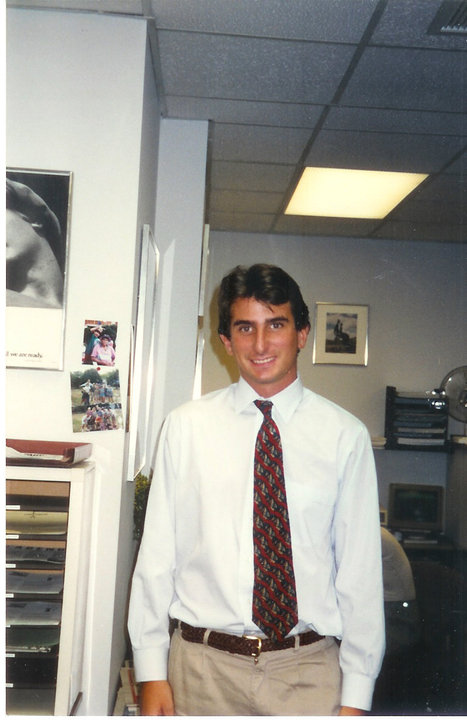
Young Andy

A few days ago I attended my nephew’s high school graduation. Really did seem like yesterday that my wife and I, along with my wife’s sister, brother and sister-in-law were watching the Mike Tyson/Evander Holyfield fight (can’t recall if it was the ear bite fight) and my two-year-old nephew was doing situps in diapers.

That was about the time I moved from New York to Dallas, and I started thinking about my career since the move – – opening and running a satellite office; the largest cross-country bike ride (at the time) in the U.S., benefiting the American Lung Association; agency-life; Breast Cancer Awareness Campaigns; State of the Air; Sydney and Salt Lake Olympics; Britney; the other Belushi; Michael Johnson (apparently my twin); World’s Largest Latte; Strategy for Answering Questions; COPD and CODP; Oprah; Christie; corporate-life; NYSE Opening Bell; spin; bankruptcy; emergence; internal; NASDAQ Opening Bell; social media; bankruptcy; emergence; merge, etc.

After the graduation, family and friends started talking to my nephew about the opportunities ahead for him. My nephew is a good young man. I’m confident he will grab whatever awaits him and will do his best. Funny thing, confidence, it is something that can make or break a career and is something I sometimes still struggle with today.

What would 45 year old (who am I kidding, soon to be 46 year old) Andy tell 1985 high school graduate Andy?

Dear Andy –

Man, you are thin. Keep that look. I know you are feeling overwhelmed. Leaving home for college is a stressful time. Fear of the unknown. On your own….hey, hang on, this letter is supposed to make you feel better, but I can tell it is just freaking you out even more.

Damn. Let me try this. Here is a picture of your family. Your wife… I know, right? Beautiful! And here is your son – – he’s 13 and your daughter , yes daughter – – she’s 10. Pretty awesome, right? Let me tell you a few things that will help you get to this “awesome” place:

  1. Breathe – Deep breaths. Enjoy everything that life has to offer you. Explore and embrace. Ask and learn.
  2. Stay true to yourself – No shortcuts. The key is to be able to look at yourself in the mirror every night and know that you were the best Andy you could be.
  3. Use “What if” wisely – I used to think, you never what to say “what if I did that” because you don’t want to have regrets or feel like you should’ve done something. While I absolutely still believe that, make sure you look at opportunities with a “what if” type of wonderment. The biggest challenges can be solved with that mentality.
  4. Don’t be afraid to fail – I can show you some of your grades and while it is obvious you will nail that, that’s not what I mean. Try new things; step outside your comfort zone and learn from your mistakes.
  5. Observe the Golden Rule – There is a reason why it’s called Golden, not silver or bronze. Live by it.

Couple of other things. Be passionate in whatever you do. Love and laugh hard.

Don’t let others define who you should be or what you should do. Apply these rules to everything you do in your life. Work…play…life.  When 65 year old Andy leaves  45 year old Andy a message, remember to open it. And lastly, when you are in France don’t leave your bags unwatched when you go to the newsstand to check the Yankees score.

Always remember, a little song, a little dance, a little seltzer down your pants.

Fondly,

Andy

Not So Social: When the Customer is Wrong

cheers

Funny thing about social media. Everyone has a voice. Can be a right voice. A left voice. A loud voice. A quiet voice. Can be part of the vocal minority or part of the crowd.

No matter your views, social media provides you and me with an open invitation to say what we feel, sometimes void of little things like facts, perspective or sound thinking.

Heck, companies not only have a presence socially, many openly ask for customers, clients, vendors, partners, etc., to “tell it like it is” – – well, at least tell it like they think it is.

And there is absolutely nothing wrong with that. There is absolutely nothing wrong with that as long as we all understand the rules of engagement.

Four or five years ago, I started my current company’s Facebook and Twitter pages. Out of necessity, really. I had begun responding to inaccurate posts and blogs about my company and/or industry and used Twitter to search for those blogs in question (the thinking was, bloggers would use Twitter as a way to distribute their blogs). During this process, I came to the “brilliant” realization (I really do need to invent the sarcasm button on the keypad) that my company should be proactively getting our messages out to our real audience. Hence, our social pages were born.

Along with the proactive posts, came responding to client concerns. A beautiful thing that can prove beneficial to both the company and the client or customer.

You see, one of two things should happen. Either it is determined that the company did something wrong and it becomes a chance to make it right for the client/customer and a learning/teaching opportunity for the company. Or, you learn that the client/customer is not being 100 percent accurate/honest/fair with the claim and it really isn’t your fault.

No matter the instance, typical operating procedure has become to quickly acknowledge the customer/client complaint and to – just as quickly – take the conversation off of the social page and onto the corporate email, phone call, etc. That is, until a positive resolution is met and either the company or customer goes back online with the happy ending.

Unfortunately, this isn’t always happening. More and more I am seeing companies that are short on follow through and customers and clients who are long on reasonable. There are plenty examples of companies overpromising and under delivering to their customers and examples of “rogue” customers posting unfounded claims, making different social sites their playground for getting back at a company they believe wronged them.

So, what is a PR person to do? Here are a couple of thoughts:

Get the buy-in of the C-Suite by showing the power of social media. Capture all of the comments real-time and graph the trends. Are their certain areas that are consistently questioned? Are comments tied to a specific promotion? A specific department? Are you seeing similar complaints from other touchpoints?

Work with the right departments within the organization to get resolution. Social media cannot be a catalog of complaints where we just say, “sorry, we’ll try better.” We must be able to have a team in place that will be able to get answers. Why’d this happen? What are we going to do to make it better? What are we going to do to assure it doesn’t happen again?

Act as an advocate for the consumer but have your company’s back. Do what you can for the consumer, but make sure he/she is acting professionally and or civilized. Profanity, lewd behavior is unacceptable and should not be tolerated. Have that as part of your company description on your home page.

I’m not someone who believes that every social interaction should be kept for prosperity. If/when someone is anti-social, protect your brand and don’t give them a platform.  Being the loudest doesn’t make you right, and if someone becomes that out of control, cut bait.

The Golden Rule truly applies here. If your company has done something wrong, fess up to it, learn from it and move on. If a customer/client is being rude, profane and unreasonable, put a stop to it. It is more than okay to block them from your page if they are so over the top.

What examples do you have of a company doing right socially? Have you seen a customer go awry? Would you block someone? Let me know, please.

The New Company Spokespeople are on Social Media Sites and Instant Chats; Should Execs Be Afraid?

RT_PhotoNight_I_003-2

When I was in college, I remember taking a Public Relations Case Studies Class. In it, we talked about the different crises of the day. “What would you do about the Tylenol tampering?” My response was usually, “I wouldn’t ask a kid right out of college.” Not the most profound of answers, I know, but the truth.

Fast-forward a few years and I’m working at a boutique agency, defending myself to my seasoned boss for not getting two placements a day (quick math, 10 a week). Not ”interests” or “sounds promising” – – actual “that will be running on Tuesday” placements. My response – to myself, my boss scared the heck out of me – was usually, “excuse me unreasonable person, you need a much more experienced person to consistently get 10 placements a week.” And for the record, I was not lacking confidence at all, 10 placements for what I was pitching wasn’t reasonable.

Compelling message, meet appropriate audience. Looking back, whether dealing with a crisis or a proactive pitch, you need to have the experience and training to be adept in creating/developing/sculpting that compelling message for that appropriate audience. I think we can all agree that makes sense. Yes?

So, why is it we are seeing more and more unskilled/untrained individuals manning (or womaning) company social media sites, Instant Chats, etc.?

This past week we saw McDonald’s get some flak for tweeting about the happenings in Cleveland. Closer to my home, my wife was trying to buy a present online with a major retailer only to learn that a receipt with the prices would be included with the gift. My wife Instant Chatted with the retailer, and received a response from the retailer tad amount to, “dude, that sucks for you.”

Understanding economics may prohibit having seasoned PR people available 24-7 to either act as a company spokesperson or respond to a “crisis” situation, it is critical to embrace the reality that those individuals who are on the Instant Chat, Twitter, Facebook, etc., are representing your company. Would you let an untrained person talk to a reporter at The Wall Street Journal? In many ways, today’s consumers are all reporters.

Make no mistake, this is by no means an indictment on the twenty-somethinger. Not at all. All I’m saying is, whoever is going to be working the new technology should understand that they are representing the company, and in doing so should consider the following:

  • Know your brand – You are not responding, your company is – – doesn’t matter if you are having a bad day, want to say something that is clever, or think the person you are talking to is unreasonable. I wrestled in high school and when we won the state cup and were presented      with jackets, I remember my coach telling us, “When you wear the jacket, you are representing Baldwin wrestling. Act accordingly.”
  • Empathize with your real audience – Why are they reaching out to you? Odds are, not to just say, hi. There probably is an issue and it was important enough for them to reach out.
  • Make sure you know what you can promise and deliver on it – You may start off as the consumer’s advocate, working with other departments within the company. Keep in touch with your customer (yes, now they are your customer) and, if possible, take the conversation off the public page until the resolution. Your customer may not agree with the outcome, but the hope is he/she (and everyone else reading the string) will understand.

A couple of years ago, I developed my current company’s Facebook and Twitter pages and responded to more than my fair share of inquiries.  Now, I have a very skilled (and I believe twenty-somethinger) monitoring and responding. She keeps me in the loop with her interactions and will ask for counsel when needed – – funny thing is, after all these years, I still think back at what my high school wrestling coach said. Still applies today.

Monkeying Around With Words

Monkees_718_400_80_s_c1

Words are powerful. They can unite. Motivate. They can hurt. Misrepresent.

Love. Hate. All. None.

In our field, words are the foundation of strategic plans; the essence of key messages and the tools used to convince, sell and explain.

Why then are so many, so quick to treat words as gospel? And why are so many, so quick to spread the words without fully embracing or understanding the ramifications of the words?

Ready, fire, aim.

Recent current events have only solidified trends that have been occurring for years. And social media has kicked it up a notch. How many times have we seen something reported and retweeted only to find out minutes or hours later that it was inaccurate?

But what should we expect? We stretch the truth every day for a myriad of reasons. How often have you been in a meeting where you hear someone say something like, “Nobody understands the message” or “Everyone thinks that is a bad idea.” Really?

Come to find out that the “nobody” was really three emails and “everyone” was a group of people at a happy hour.  In other words, not so much nobody and everyone.

Jon Stewart has said, “If everything is amplified, we hear nothing.”  Amplification occurs when words are used carelessly, without checking the accuracy. We’ve become numb, substituting truth and fairness with being first and whenever possible our take on a particular situation.

The great philosophers Peter, Micky, Davy and Mike once sang, “I remember when the answers seemed so clear; we had never lived with doubt or tasted fear. It was easy then to tell truth from lies; selling out from compromise; who to love and who to hate, the foolish from the wise.”

While I’m certainly not naive to think the world was much clearer years ago, I do think much of society’s quench for 15 minutes of fame has taken the idea of “the truth, the whole truth and nothing but the truth” to a much broader interpretation. And Facebook, Twitter and social media in general has given us the platform to shine the spotlight large and bright.

I don’t know what the answer is; I do know part of my job is developing compelling messages for appropriate audiences. It can sometimes take me quite some time in determining the right words for the right people. Maybe we’d be better off if we all took a moment to breath before both sending/saying something and considering the source. Maybe not, but at the very least I wrote a blog that included Jon Stewart and the Monkees.

When “Telephone” Isn’t A PR Person’s Best Friend

ImageShow of hands. Who remembers the game telephone? You know, a group of people whisper in the ear of the person next to them whatever a different person whispered in their ear. Invariably, by the time the last person repeats – out loud – what the first person said, it is very wrong.

Whether the saying was difficult to remember, someone heard it wrong, intentionally said it wrong or wasn’t paying that much attention to begin with, the message started with ends up very different from what the last person said. The game was always good for a few laughs.

There is an adult version of telephone going on these days, however I don’t think it is very funny. This version features many more people and the ramifications for getting it wrong are no laughing matter.

In this game, when news happens some less than “calling it down the middle” is happening:

  •  More and more commentators are reporting the news without true training and – sometimes – with a preconceived bias are getting the facts wrong, ignoring them or putting their slant on things.
  •  Television news teases – wanting to draw viewers into a story coming up after break and put together by someone other than the reporter we worked with – could be somewhat inaccurate/dramatic.
  •  A headline, written by someone other than the reporter we worked with, would be sensational so the reader would…well, read on.

Now, for the most part, I don’t think the media tries to get it wrong – – it only hurts them in the long run – – but the result  becomes magnified in this social world.  The real audience who may not be paying full attention/not read the full story/etc., are tweeting, blogging, posting, etc., the story as gospel.

The reality is technology is facilitating the journalists who “need” to be first in reporting “facts” for a myriad of reasons and the non-journalists (you and me) who “need” to be first in letting their friends/acquaintances know that they are in the know.

The good news is technology also helps people like me. People like me whose job – in part – is to control the message.  We can:

  • Monitor posts to see what is being said, who is saying it and who is listening.
  •  Respond, when appropriate, to those who are getting “it” wrong with the facts and a link to relevant information/data/etc. that substantiates your point.
  • Determine who the big voices are and who should be contacted.
  • Create blogs/post with relevant content telling your side of the story.

While technology has many upsides, don’t forget to go to the source if they’ve gotten it wrong. There have been several times where I’ve reached out to the media when a headline wasn’t accurate or a tease a bit misleading. The key is to always deal with facts.

While responding to everyone may not be practical, reaching key people is certainly viable. Like anything else, we aren’t going to be able to reach everyone, but technology will allow us to establish our side.

The “New” in the News Release

wow-copy-300x249

A little over a month ago I wrote a blog called The Days of Major Media Using Your Release Verbatim are Over (Not That They Were Ever Under). My premise was pretty simple (for those who have been reading my blogs, know I excel in simple) – – major media aren’t waiting for a news release to come over the wire so they can just “copy and paste” onto their outlet.

Responses I received were at times passionate and always thoughtful. First off, what do I mean by major media?  Second, U.S. media is different from media across the world. Some outlets will use parts of a release verbatim – – government, medical, sports, etc. The goal of the release is to illustrate what a possible story could look like. And on and on and on…

Awesome feedback. Couple of things that I took from the comments and, in some instances, ensuing back and forth:

Doesn’t matter if the release gets used verbatim. What matters is getting the attention of the reporter by providing her/him with a compelling story for her/his readers/listeners/viewers (who are your real audience).

How you write the story does matter. It is everything. Yes, AP Style. Of course, proper grammar. But what is going to make or break you is creating a story that is written for the media, not your client. This means thinking like a reporter and not worrying if your client’s name is in the first sentence or first paragraph when it doesn’t fit. It means using a quote only when it truly moves your story forward, otherwise not using it all.

This is not always going to be easy, and there will be instances when you shouldn’t fall on your sword over this, but for those times when mentioning “Company X” right away doesn’t make sense – – stick to your guns.

When would this occur? Lots of examples:

Perhaps a technology release where you are going to talk the benefits of the innovation first and follow that with what made it possible.

Maybe for the anniversary of a restaurant, you want to start with a story of a couple who were engaged at the eatery 50 years ago.

I think you get the idea. Bottom line is we are the experts in how to best secure coverage and how to best utilize the news release which, by the way, does not and should not just be used for going to the media. Blogs and social media are great venues for news releases/stories. And just like the media (who are taking your story to your real audience), those individuals who are reading your blog and social pages don’t want to get hit over the head with repeated corporate plugs.

The Evolution of the Placement: Taking “Crawl, Walk, Run” Up a Few Notches

toddlers running

I coined a phrase many years ago, describing a strategy for building a successful media relations campaign. Wasn’t relevant for every situation, but I thought it sound, and a good way of managing expectations.

The idea was “Crawl. Walk. Run.” Pretty self-explanatory and an easy way of illustrating the process.

Crawling would take place when you secured a trade placement. Calling a trade placement crawling was not intended to diminish the placement. Trade media and analysts covering a particular industry can be critical in the foundation of coverage.

Walking would occur when you took that trade placement to an outlet like a beat reporter at a daily newspaper. The thinking was, the beat reporter would be familiar with the trade outlet and your pitch would hold more credence. A couple of daily hits and well, you are now walking.

We would be running when national media – – broadcast, print, magazine, etc. – – would do a story based, in part, on those daily newspaper placements.

While I still believe the strategy to still hold true, new times and technologies have added opportunities as has a more sophisticated way at looking at your real audience.

Today, the savvy public relations professional doesn’t and shouldn’t solely rely on the media to reach his/her audience. Blogging, creating relevant videos, posting appropriate content socially, helps create a direct line to the people you want to reach. In most instances, less total people – initially – than a huge media placement, but – if done correctly – just as much impact because you are hitting the right people.

What you lose in third-party credibility, you gain in controlling the messages and interacting directly with your consumers. That said, creating content is not as simple as talking about your latest and greatest product or service.

Sure, individuals who follow your company, product, service, etc. do want to receive some information/coupons/offers, etc. specific to your company, but they want more. It is about providing relevant, compelling content that will keep your real audience interested and coming back for more.

For example, the smarter/better retail companies are probably blogging about their given expertise and posting it on Facebook (along with coupons, etc.). To be clear, the content is not a commercial. You are telling an interesting story without bombarding your real audience with your company name, product, service.

The great thing for PR folks is, that content (and it could be a blog, video, etc.) can and should be used as possible pitches for media. Producers, reporters get a good idea of what the story could be and if your content spurs comments, more the better.

More and more, the media are covering what is happening socially. During a talk at Vanderbilt, a student asks Billy Joel if he can play New York State of Mind on the piano. Many YouTube views later, the student ends up talking on TODAY and appearing on other media outlets. As PR professionals we should be doing the same thing – – asking Billy Joel if you can play piano for him… No, not that, but we should be building relevant content and using that content as a tool for pitching the media.

One of our responsibilities is establishing positive relationships between our client and their real audience. Building great content that the real audience can use directly and the media can use to create new content to a broader (if done correctly) real audience comes down to a Matter of Trust (see what I did there, used another Billy Joel song to reinforce my point, I know a bit cheesy, but what can I tell you, I’m a fan).

Controlling the Controllables (or the Time I was Confused for Olympic Gold Medalist, Michael Johnson….No, Really)

JOHNSONOn more than one occasion, I’ve been told I can be intense at work. Not the “I’m a teepee, I’m a wigwam, I’m a teepee, I’m a wigwam” intense, but the “get out of his way when he’s coming down the hall” intense.

Whether it is my “game-day” face, the New Yorker in me or “get it done” mentality, I wouldn’t necessarily say I’m being intense. I would say, I’m controlling the controllables.

So, what does that really mean? Well, one of the aspects of public relations and media relations that I enjoy the most is the art form (yes, I believe it to be an art form) of creating the news and seeing/hearing it online, on the radio, television, print. For me the fun is in as much the journey as it is in the end result. It’s great to see/hear the reporter encounter the “Oprah Ah-hah Moment” and reap the rewards of that third-party credibility.

After all, in so many ways, that is the name of the game – – third-party credibility. It is one thing to have me tell you how compelling/important/awesome something is, but it is so much better else to have Robin Roberts, Katie Couric, your favorite reporter/columnist, the morning radio host, etc., say so.

However, one of the inherit challenges that goes along with this, is a little thing I like to refer to as Breaking News.

We all have tales of our stories being bumped, preempted, postponed because of breaking news. Our stories, events, news conferences, etc. compete with the real word and sometimes, the real word happens. And try as we may, the real world isn’t controllable. Therefore it is incumbent on us to control the controllables.

Below are some thought on how to do so. For the sake of this discussion, I’ve included thoughts when dealing with an event, news conference or story.

  • Be vigilant – If you are planning a media event or news conference, the real work starts days/weeks/months before the event. Is it the right story? Is an event or news conference the best way of getting your message across? How accessible is the event/conference to the media? What type of media are we targeting? Don’t rely on lists. Have actual one-on-one interaction with the media. Can materials be developed in case the media get called away day of the event? Spelling counts in whatever we do as does Associated Press style.
  • Ask questions of the media – Our work doesn’t end when the media say yes to our pitch. The more information we can get the better. Participate in the process of developing the story. How is the client plug going to be included? Is this going to be a roundup story or a feature? Interviewing other people? Will a reporter be attending the event or a camera person alone?
  • Update your client/manage their expectations – It is one thing for us to know that Breaking News happens. It’s another to make sure our clients understand it too. The more relevant information you can provide, the better.
  • Never say never – Now, just because breaking news bumps your story, it doesn’t necessarily mean you are finished. Consider producing your own b-roll of your event. Can a photo be used online? Can you do the interview a different time? Can you blog about your story? Post video or pictures on your company Facebook  Page and Twitter Feed?

So, when was this slow, not shall I say “cut” man (that would be me) confused for Olympic Gold Medalist, Michael Johnson? And how does it relate to controlling the controllables? Prior to the Sydney Olympics, my client at the time was hosting a press event in Atlanta with spokesman, Michael Johnson. We had area kids at the press conference and Michael was going to introduce my client’s program that would feature Olympic hopefuls.

We had worked long and hard on the event. Two junior staff members (who I’m very proud/happy to say are now anything but junior; both are well-respected and quite successful) and I had spent the better part of a month developing the logistics behind the conference and worked the phones in making sure the media were well aware of the details.

As “luck” would have it, disgraced Major Leaguer, John Rocker, chose the same time as our event to call a news conference to discuss some “controversial” comments he had made. I received the call in the car service from my teammates who told me the news. I could hear from their voice that they were not only disappointed but a bit apprehensive as to what my reaction would be – – in retrospect, I guess I had my “game day” face on for a couple of weeks.

I believe – much to their surprise – I was calm. I knew we had controlled everything we could, and both the client and Michael were well-briefed on what we had done to prepare.

The news conference ended up going well and we had good media coverage (I guess Rocker really didn’t have all that much to say). As I was wrangling the press and letting Michael speak with different reporters, one woman came up to me with her son and asked me for an autograph.

I looked curiously at her and asked why she would want an autograph from me.

“You are Michael Johnson,” she asked.

No ma’am. The athletic looking gentleman in the Olympic sweat shirt, flanked with all sorts of media, THAT would be Michael Johnson.   Me, I’m just a PR guy who, like James Cagney, is a song and dance man (even though I can’t sing or dance) at heart.

Five PR Pet Peeves: Rolodex, Spaghetti, Spin, No Such Thing, and Taken Out of Context

030509peeve-01

I thought it might be fun or at the least a little cathartic to write about some of my “favorite” pet peeves regarding my given profession.

So, without further ado, I present to you – in no particular order – five of my all-time “please don’t say that” pet peeves:

#5: Client or prospect says, “I want to hire someone that has a good Rolodex” insinuating that the relationship we have precludes the story we are pitching.

Not so. This is a business and it is about creating the compelling story for the appropriate audience. The story is going to determine who we contact. These days with email, Twitter, Facebook, Skype, the phone, etc. it is easier than ever to reach the media. But reaching the media is one thing, providing them with a great story is something else. And that is how you build a relationship. Doesn’t matter how big my Rolodex is, if I don’t have the right story and the good PR person isn’t going to reach out to a reporter/producer just to reach out to them.  This leads me to another peeve of pets –

#4: Those who want to send the pitch out to everyone and see who picks it up.

Now this can be a client, account executive or anyone who isn’t interacting with the media. I call this the spaghetti theory (throw it on the wall and see what sticks) and it is one of the worst things you can do. The media get bombarded with pitches. It is our job to act as a gatekeeper for them in determining what pitch makes sense to the right media. Consistently sending out the wrong pitch to the wrong media will alienate your client and your credibility. I understand saying “no” to a client can be difficult, but managing expectations and explaining your rationale comes with the territory.

#3: Let’s spin that. Put a positive spin on that. Go do some PR on that.

Spinning something to me sounds like we aren’t telling the entire truth; holding something back. I hope that’s not what we do – – not sure I’d be able to look at myself in the mirror. Public relations is about getting all sides of the story out. You may not always agree, but a good public relations pro will illuminate a situation. We don’t lie, hold information or mislead.

#2: There’s no such thing as bad PR.

No. No. No. No. Not true. There is such a thing as news cycles and it has been shown that many societies can be forgiving (or somewhat forgetting). Really rather not be in a situation where how I react to something will dictate someone’s future. I could not disagree more with this. Or this –

#1: I didn’t say that. The reporter took what I said out of context.

Actually, odds are you did say that and the reporter just included what you said. Reporters don’t want to be called out for getting something wrong, not good career moves for them since they rely on being reputable. More often than not, those who have been “quoted out of context” did say it, but did not plan out what they were going to say. Before any interview, everyone should go through some form of media training, or – as I was taught – a Strategy For Answering Questions. Doing so will “amazingly” stop those “I didn’t say that” moments.

Surely you have your pet peeves (and don’t call me Shirley). What are yours? You agree with mine?

When a Great Placement Isn’t: How and Why To Manage Expectations

thumbsupdown2

I was thrilled. Front page of USA Today’s Life section. The “Featured Story” that went onto another page.  Cover picture of my client’s book and another picture from the book on the second page of the story. Client was the expert, quoted several times throughout the piece. Made me and everyone who called, emailed, and reached out to congratulate me, want to buy the book. Really was beyond my wildest expectations.

Problem was, it wasn’t beyond my client’s. Problem was, my client was looking for a book review. Problem was, I didn’t manage his expectations.

This was more than 15 years ago and I’m quite confident my client was happy with the placement, but was looking for any excuse not to pay. Looking back, I shouldn’t have been surprised. He was not a standup guy. That said, I didn’t do my job. That said, even more of a reason to manage expectations (unfortunately it is sometimes covering yourself). A lesson learned. A lesson I will never forget.

When it comes to managing expectations, it comes down to two things: Understanding the media and understanding your client (and your client can be your boss/CEO if you are on the corporate side of things or, if you are on the agency side your client can be…your client).

  • Understanding the media – It’s not good enough to “just” get the placement. Our work is just starting. We really need to fully understand what the media is thinking so we can provide the best opportunities for our client. Research the media ahead of time so intelligent questions can be asked and ideas to better the story can be offered. Who else are you interviewing? Would you consider talking to an industry expert who covers our company? When is the story going to run? Is it a round up story or are you featuring us? What segment will we be featured? How long will the segment be? Will the host be mentioning my client or is it the responsibility of our spokesperson to give the mention? The point is, there is so much leg-work that takes place after the media’s, “yes” that can impact the quality of the placement and set the expectations of your client.
  • Understanding your client – How much does our client understand the media and how much do they want to understand? This is important – – need to make sure we are talking the same language. Before any campaign or effort involving the media, it is critical to determine what the client wants to get from the placements. Sales? Brand awareness? Facebook likes? Increased employee good-will?  Communication of key messages? Our ability to successfully table-set what can be done and how it can be done will dictate the quality of the relationship.

Managing expectations is something every level public relations professional should understand and practice – – even if you aren’t the main client contact. Arming the client lead with the appropriate information can only be of a help.

What about you? Any stories of managing expectations gone awry? What was the one question you asked a reporter that you never thought you’d ask?